

Just the other day, Transformation Marketing received mail from Yellow Pages United. This may not sound strange at all− in fact, it probably sounds quite ordinary that as a small business, we would want to be listed in Yellow Pages and potentially advertise our services. However, this is actually a scam. We want to send out a warning to our clients and our readers to ensure you all don’t fall into this trap or similar scams that happen to companies all the time.
The particular piece of mail we received was labeled as a directory listing order form of sorts for Yellow Pages United, the phone book company. This letter was labeled “THIS IS NOT A BILL” in big boxy letters, clearly to draw our attention. Below this, “no additional charges to include your fax, toll-free number and web address,” was typed. By the text on the mailer, one would probably assume that by filling this out and returning it, what the instructions say to do, you would not be paying any money. You would be filling out the directly listing and then moving on with your day. This is a very valid assumption,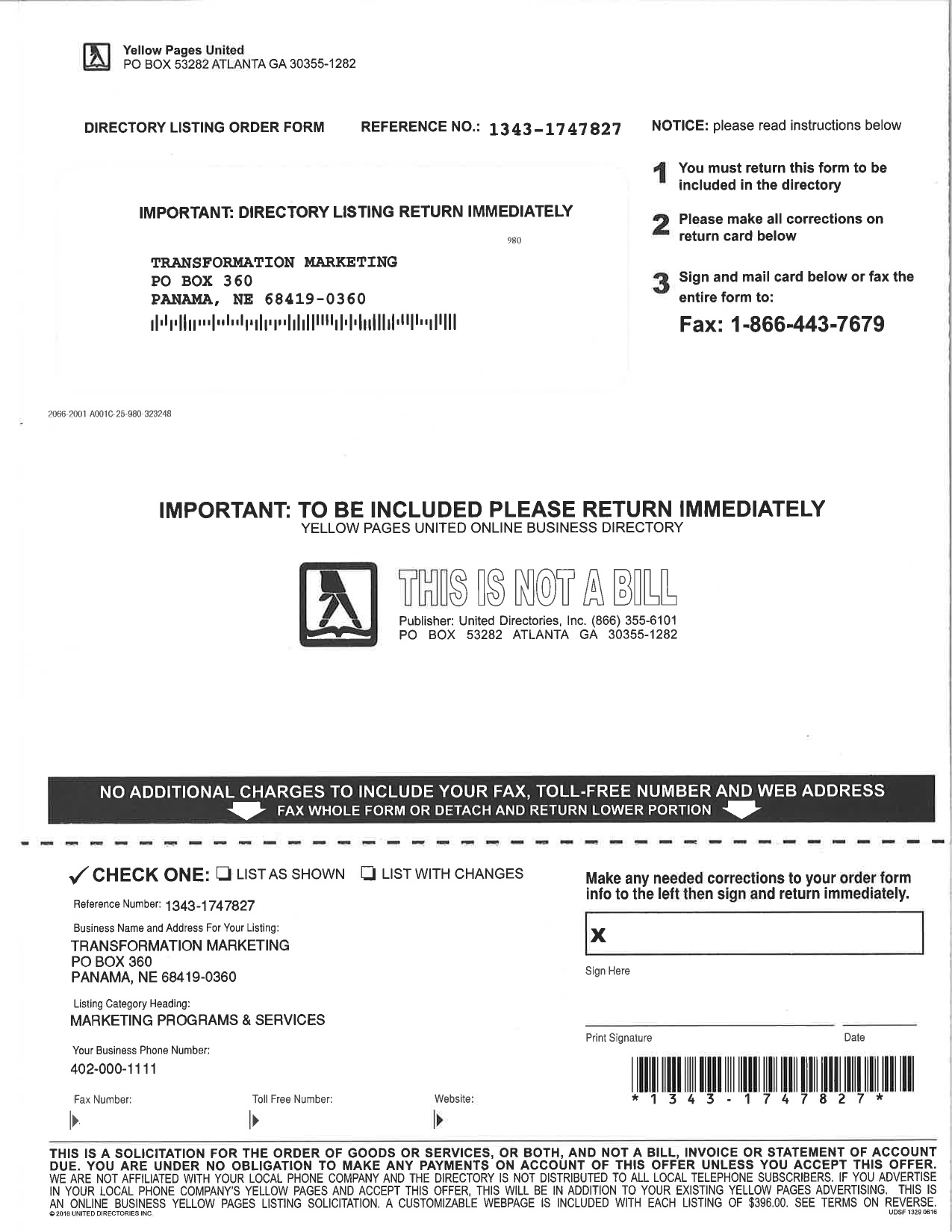 but very wrong.
This is a great example of scams that are often done by phone book and other companies to trick you into giving them money. If you read the fine print on the mailer, it states that there is a $396.00 charge for filling this out. But wait, didn’t the mailer say in bold letters, “this is not a bill?” By filling out this form and returning it immediately, we would be charged nearly $400, plus the added fees for additional Yellow Pages listings.
This is a fairly typical scam that happens way more often than one would think. At another phone book company, they asked the client to sign off on some changes that had been made to their information. What the client didn’t know was that they were actually signing a contract for another year, and therefore another large fee. This type of scam often happens over the phone when con artist calls claiming to ‘verify’ or ‘confirm’ a company’s contact information. There is most likely not an existing listing or there may not even be a real business directory, but the employee on the phone is unaware of that. These con artists are persuasive and will manage to get the employee to say yes. When the company says they didn’t agree to the listing, the scammers can use this phone call as proof. This kind of contact can go back and forth until eventually the con artist wins and receives a pay out by the company.
So the moral of the story is be aware that these types of scams are always happening. Always read the fine print on mailers, like the one we received, and in emails. Also, be aware of who you are talking to on the phone and what information you are giving them. We don’t want to see our clients, readers, or anyone else fall into these schemes!