


Previously, we went over Basic Camera Movements, this time we are upping our game (and day rate) and will be going over a few Advanced Camera Movements – this time, we have video examples! YEA VIDEOS!!! Sometimes we need to achieve a specific look or effect, or maybe we just want to make our video more dynamic… this is when we start looking at advanced techniques.
1. Tracking Shot
A tracking shot is when the camera follows a subject (usually a person, but sometimes an object, like a car) during a scene. This shot is usually accomplished by using a dolly system, jib crane, or stabilizing system. The later two systems allow for the camera to move more freely with the subject.
One of the most notable examples of a tracking shot is from Goodfellas, when Henry walks Karen into the club. The camera starts out on the street with the couple, and follows them through a side door, along a back hallway, into the kitchen … all the way into the club, where they get the best seat upfront by the stage. Notice how, even though we are following Henry, the camera will pan to different objects in the scene, and different people walk between the camera and the couple, but the camera stays with them. The distance may also change, but the camera stays with them, giving the audience the feeling that we had been tagging along.
A recent director, Alfonso Cuarón, has made tracking shots somewhat of a signature. In his film, Children of Men, there are multiple tracking shots, which last three to six minutes each. At the 2014 Academy Awards, Cuarón and his Director of Photography, Emmanuel Lubezki, won the Oscar for “Best Achievement in Cinematography” for Gravity. The opening scene in Gravity is a continuous shots lasting twelve and a half minutes.
Goodfellas Example:

2. Jib Crane Shot
A jib crane is used for smooth, moving shots that would be difficult/impossible to achieve if the camera and operator had to stay on the ground. A jib crane (sometimes just “crane” or “jib”) has a camera mount at the end of an arm, and the other end is counterbalanced for weight. The mount can have tilt, pan, and maybe even 360 degrees of articulation. A jib crane basically allows the camera to float in the air and capture wide, sweeping shots. Jib cranes can be used for tracking, establishing, or group shots. They allow the camera to be used in different places and angles, which will create more interesting and dynamic shots. This could be especially effective with stationary subjects, such as furniture or cars. The movement of the camera makes the subject more interesting, and can also show different, engaging angles of the subject.
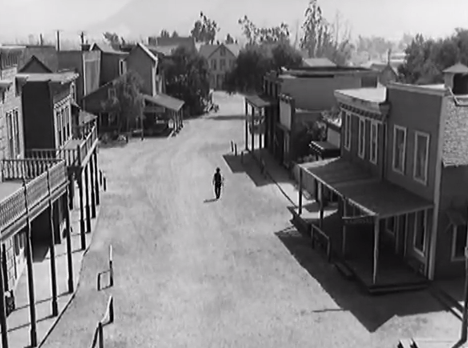
High Noon Crane:
3. Dolly Zoom

A Dolly Zoom has many alternate names including, “Push/Pull,” “Zolly,” “Hitchcock Zoom/Shot,” “Vertigo Zoom/Shot” and the list still goes on! It is a pretty technical move, and I think the video examples will be very helpful in understanding how this shot works. It was famously used in Alfred Hitchcock’s Vertigo (see example below).
This effect is created by moving the camera toward or away from a subject, and while the camera is moving, the zoom on the lens is adjusted to counteract the camera’s movement. The counteraction between the camera’s movement and the manipulation of the zoom keeps the subject the same size in the frame, but the surroundings seem as though they are rushing in towards the subject or stretching out away – depending on how the camera is moving.
This happens because as the zoom level is increased on a lens, it “flattens” the image and makes it appear that the background is closer to the foreground. And the opposite is true for wide zoom lenses; the background and foreground appear to be further apart.
When executing a Dolly Zoom In, the camera starts away from the subject and the lens is zoomed in tight (a high level zoom). The camera is then moved (or dollys) toward the subject, as the camera moves, the zoom is reduced to a wide shot. A Dolly Zoom Out is the opposite. The camera starts close to the subject, lens zoom is wide (a low zoom level), and as the camera moves way from the subject, the zoom is tightened. It is fairly tricky to match the camera movement and zoom needed to create this effect, and requires many attempts to get a usable shot.
This technique has a few different uses. In Vertigo it was used to lengthen the stairwell to portray Scottie’s fear of heights. In Jaws, it was used to heighten the scene as Police Chief Brody realizes the shark is in the water near the swimmers.
Vertigo Dolly Zoom Example:

Jaws Dolly Zoom Example:
Since these are “advanced” camera movements, they do require experience. You might not be able to achieve exactly what you want on your first attempt. At Transformation Marketing, we are always striving to be better and push our own limits to deliver a great product for our clients. If there is ever anything you need from us to better understand your project, please never hesitate to let us know!