
So you’re a proud entrepreneur. You’ve got a rock-solid business plan, dedicated employees, and best of all: a beautiful, brand spankin’ new, 100% custom-designed logo ready to be plastered all over your marketing materials.
You’re driving through town, feeling pretty great about everything – at this point you’re making a mental note to get your new logo turned into one of those sleek vinyl decals for the side of your car – when something catches your eye and makes you look upwards. Towering 20 feet above you is your logo. 40 feet wide and in full color, there’s no mistaking it. Yes, that’s definitely your logo standing high over one of the local car dealerships in town.
But you don’t own a car dealership. And apparently that custom-designed logo your designer promised you was…well, not so custom after all.
—–
You’d be surprised how common this scenario is: Business owner meets designer, designer meets business owner, promises are made, and for one reason or another (apathy, incompetence, laziness, etc.) the business owner comes away with a product that falls short of the too-good-to-be-true promises that were made.
This situation is what we like to call a lose-lose-lose. The original designer loses out on credit (not to mention compensation) for their concept, hard work, and talent. The business owner not only ends up paying for more than they actually receive, but also loses out on the promise of a truly one-of-a-kind design and identity: a priceless commodity in the marketing world. And although the “designer” who ripped off the original artwork seems to come out on top, he or she loses all credibility once their faux-designer identity is exposed.
You may have noticed we’ve been throwing around the word “original” a lot in this post, so it might be helpful to take a closer look at that word to understand what it means in a creative context.
Mark Twain said it best:
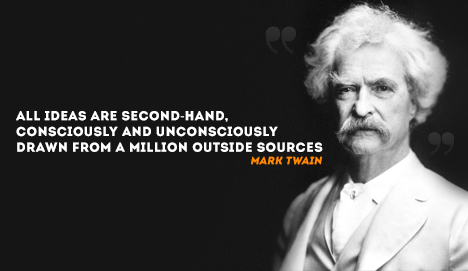
No designer (or anyone in the creative field for that matter) creates his or her work in a vacuum. We’re influenced by our favorite artists and gather inspiration from every aspect of our lives: from the curves of a high-end sports car to the certain shade of yellow in a mustard bottle. Does this mean we have to ask permission from Heinz before using Mustard Yellow in a design? Of course not. The thing that sets great designers apart is their ability to draw from various sources of inspiration and meld those ideas with personal experiences and styles to create truly one-of-a-kind products to achieve the goal of the client they are serving.
With that in mind, it is reasonable to expect some crossover in logo designs (and design in general). After all, someone has yet to trademark the circle (don’t get any ideas, Target…). However, the shameless copying of an original logo design does not happen by accident or coincidence.
Exhibit A:

Photo from logothief.com
It’s clear that the logo thief made almost no attempt to hide their crime. Deleting original design’s crown and adding a poorly centered “O” just isn’t enough to get away with this blatant case of theft. Check out www.logotheif.com for more examples like this.
The sad thing is that many business owners unknowingly accept rip-offs as original work simply because they are mislead by their designer. Luckily, we’ve got a few tips to help you protect yourself and your business from designers who might lead you astray:
1.) Be suspicious of promises that seem too good to be true. Because they probably are. Despite the allure of a fully customized logo in 12 hours or less, keep in mind that a simple logo takes days or even weeks to create from scratch. To create a truly one-of-a-kind logo, the designer must first research your business to create a concept that is both simple and eye-catching. The concept is then sketched out, refined, sent through approval processes, re-drawn, cleaned up, and matched with the proper typography until both the designer and client are satisfied. While a process like this takes a little more time up front, the results are invaluable: a one-of-a-kind logo created for your business and your business alone. A designer who promises results like these in a short amount of time is probably taking short cuts (best case scenario) or literally tracing over another designer’s work and selling it to you as an original design (worst case scenario).
2.) Do your homework. Get serious about checking your designer’s reference page. If they have an online portfolio, spend some time on it. Do they have descriptions of their projects, photos of their sketches, etc.? Be sure to ask about their design process before you hire them. If a designer can’t come up with a few words about a project they did, it should make you wonder how much thought they really put into their work.
3.) Google is your friend. In 2011, Google released its Search by Image feature, making it harder for logo thieves to remain undiscovered. If you want to search the internet to make sure your logo wasn’t previously designed for someone else, you can now do that with a few clicks. Google will use whatever image you provided to find similar images on the internet. If any images match your logo exactly, you know you’ve got a logo thief on your hands.
There you have it! We hope that we’ve equipped you with some helpful tools and information. And remember, at Transformation Marketing, it all comes down to trust and results – so you can feel secure in your decision to let us handle your next design project!